
Clean Core, Trusted AI, Part 1: What Is Clean Core, and Why Is It Suddenly an AI Conversation?

“Clean Core” has been sitting in SAP’s vocabulary for years, mostly as a phrase project teams used to talk about upgrade discipline. In 2026, it’s showing up in board decks. That’s not a coincidence — it’s what happens when every enterprise AI initiative starts hitting the same wall.
Discipline, Not Housekeeping
“Core” is what SAP calls the five specific dimensions of your S/4HANA landscape, that determine how easily your system can absorb change without breaking. Keeping that core “clean” means staying on a current release, keeping extensions and integrations cloud-compliant, keeping data quality high, and keeping process design close to standard. For customers converting an existing system (brownfield) or standing up a new landscape (greenfield/SDT), the goal is the same either way: get the core clean, then keep it that way. This isn’t a one-time project; it’s an operating discipline, and it’s resurfaced hard over the last few S/4HANA and BTP release cycles because SAP’s own roadmap now assumes you’re on it.
Five Pillars, One Core
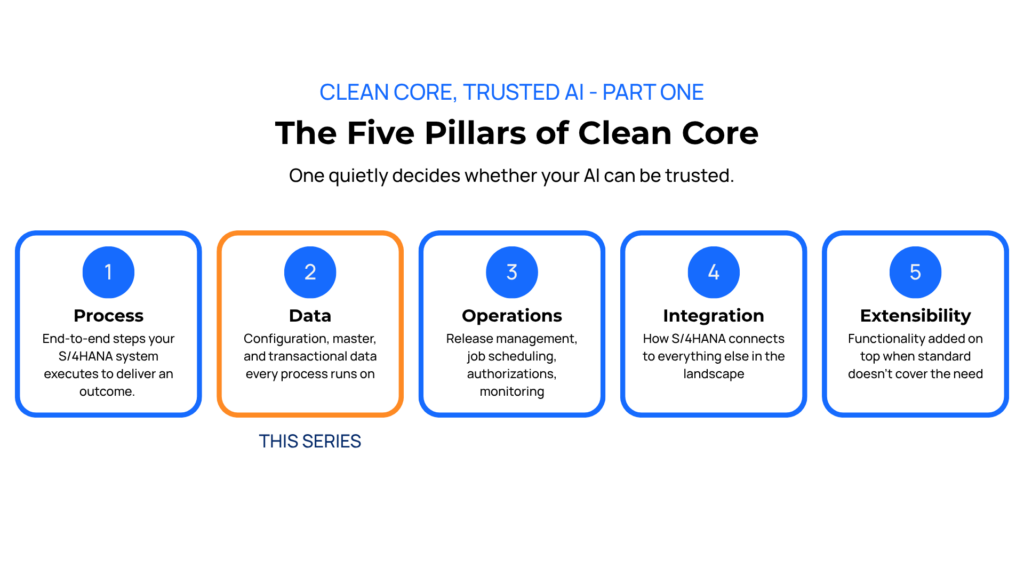
When SAP or your systems integrator says “Core,” they mean five distinct dimensions.
• Process: the end-to-end steps your S/4HANA system executes to deliver an outcome.
• Data: the configuration, master, and transactional data those processes run on.
• Operations: the maintenance work that keeps the system healthy, release management, job scheduling, authorizations, monitoring.
• Integration: how S/4HANA connects to everything else in your landscape.
• Extensibility: the functionality you add on top when standard doesn’t cover a real business need.
Five pillars, one system, one discipline.
From IT Hygiene to Boardroom Bet
Here’s the pivot. AI adoption doesn’t ask politely which pillar you’ve neglected. Instead, it stress-tests all five at once. A poorly governed Extensibility layer produces AI agents that break on every upgrade. Weak Integration produces AI that can’t see the whole picture. Undisciplined Process design produces automation with nothing consistent to automate. But four of those five pillars tend to fail loudly: a job errors out, an interface breaks, a workflow visibly stalls, and someone gets notified via email or text.
Data doesn’t fail loudly. It fails quietly.
That data is training a model or feeding an agent the wrong answer with total confidence, and nobody notices until that output is already in front of a customer, an auditor, or a regulator.
That’s the pillar this series spends the next two parts on: what “clean” and “governed” actually mean for data inside SAP, and what it’s worth funding first, once you know.